
No products in the cart.

ROCm 7.0: A Generational Leap Forging the Future of Open AI and HPC Leave a comment
The release of AMD ROCm™ 7.0 on September 16, 2025, marks a watershed moment in the landscape of high-performance computing (HPC) and artificial intelligence (AI). More than just a software update, ROCm 7.0 is a comprehensive, full-stack overhaul designed to unleash the generational performance of AMD’s Instinct™ MI350 series GPUs and establish a scalable, open alternative to proprietary ecosystems. This release is a clear statement of intent from AMD: they are serious about competing in the most demanding segments of the modern compute market by focusing intensely on the three pillars of success—raw performance, developer experience, and enterprise scalability.
I. The Foundation: CDNA 4 and the Instinct MI350 Series
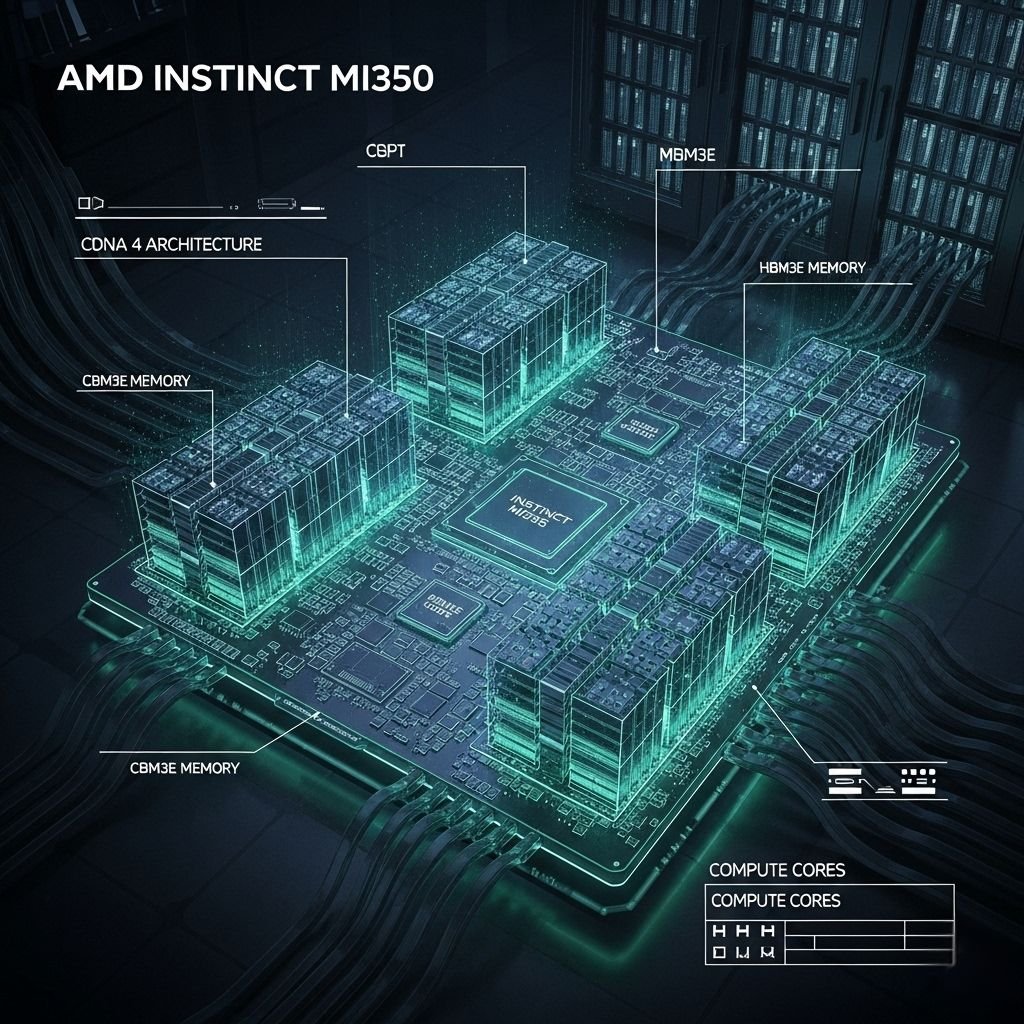
The entire architecture of ROCm 7.0 is built to exploit the capabilities of the AMD Instinct MI350 series GPUs, powered by the CDNA™ 4 architecture. This new hardware represents a significant pivot, placing an aggressive focus on AI-centric throughput and memory capacity.
Architectural Synergy
The MI350 series, particularly the MI350X and MI355X, leverages an enhanced modular chiplet design built on advanced N3P process technology. Key hardware specifications directly influencing the ROCm 7.0 software design include:
- Massive Memory Footprint: The MI350X/MI355X boasts an impressive 288GB of HBM3E memory with an 8 TB/s peak theoretical memory bandwidth. This colossal memory capacity is crucial for handling the ever-growing parameters of the latest LLMs, allowing users to fit truly massive models onto a single accelerator or a small cluster of GPUs, drastically reducing inter-node communication latency.
- Refined Compute Units: The CDNA 4 architecture features 256 Compute Units (CUs) across eight Accelerator Complex Dies (XCDs). AMD has strategically beefed up the matrix cores within these CUs to specifically enhance AI and machine learning capabilities, focusing less on traditional FP64 HPC for pure scientific workloads (though FP64 performance remains strong) and more on the dense matrix operations that define deep learning.
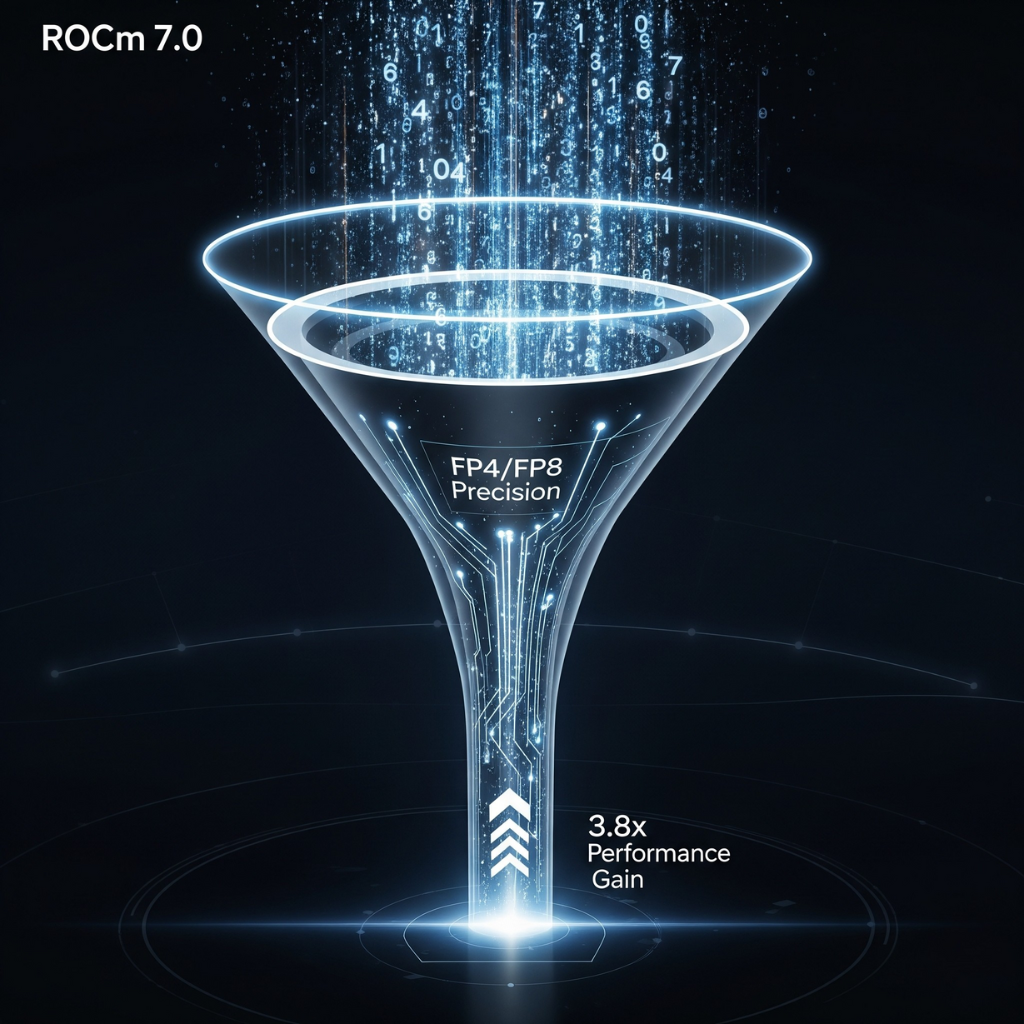
- Native Low-Precision Support: Crucially, the CDNA 4 architecture introduces dedicated hardware support for ultra-low precision formats: FP4, FP6, and FP8. This is a monumental hardware-software co-design decision, enabling the massive performance uplifts seen in ROCm 7.0 benchmarks.
ROCm 7.0 serves as the bridge, providing the optimized kernel drivers, runtime libraries, and compiler support (HIP, AOMP) to ensure that every GB of HBM3E and every matrix core operation on the MI350 is utilized to its maximum theoretical capacity.
II. The Breakthrough: Ultra-Low Precision and Performance
The most attention-grabbing feature of ROCm 7.0 is the generational performance leap, with AMD citing up to a 3.8x performance uplift in certain inference workloads compared to ROCm 6.0 on previous generation hardware. This gain is fundamentally driven by its full, optimized embrace of low-precision data types.
The Role of FP4, FP6, and FP8
In the world of AI, particularly for inference, accuracy can often be maintained even when using data types with significantly fewer bits than the standard 32-bit (FP32) or even 16-bit (BF16/FP16) formats. ROCm 7.0 capitalizes on this by introducing robust, native support for:
- FP8 (8-bit Floating Point): This is supported in both its primary variants: E4M3 (4 exponent bits, 3 mantissa bits) and E5M2 (5 exponent bits, 2 mantissa bits). E4M3 is generally preferred for model weights and activations in the forward pass due to its higher precision, while E5M2, with its wider dynamic range, can be useful for gradients in training. ROCm 7.0 provides HIP runtime APIs and library kernels (like those in hipBLASLt) to leverage these formats, drastically cutting memory bandwidth and storage requirements.
- FP6 and FP4: These ultra-low precision formats, with native hardware acceleration on the MI350, push the limits of efficiency. While introducing potential trade-offs in accuracy, the benefit in raw throughput and memory reduction is invaluable for large-scale, high-volume inference tasks, allowing LLM serving systems to maximize queries-per-second (QPS). The integration of techniques like AMD Quark, an open-source model optimization toolkit, ensures production-ready quantized models in these formats (MXFP4, FP8) are available out-of-the-box.
By processing data at FP8, FP6, or FP4, the GPU’s memory pipelines are less congested, and the matrix cores can perform more operations per clock cycle. ROCm 7.0’s compiler and runtime handle the complex mixed-precision scaling and conversion behind the scenes, ensuring the developer can focus on the model without becoming a low-level numerical expert.
Algorithmic Optimizations for Generative AI
Beyond raw data types, ROCm 7.0 directly addresses the computational structure of modern AI, especially transformer-based LLMs:
- Mixture-of-Experts (MoE) Support: MoE models are the new paradigm for scaling LLMs, where only a fraction of the total parameters (experts) are activated for any given token. ROCm 7.0 provides native, optimized primitives for MoE training and inference, crucial for frameworks like Megablocks, ensuring efficient communication and load balancing across the large number of experts distributed over a GPU cluster.
- Enhanced Attention Primitives: Operations like Rotary Positional Embeddings (RoPE), attention masking, and other reasoning primitives are foundational to the transformer architecture. ROCm 7.0 introduces optimized, fused kernels for these operations, directly reducing kernel launch overhead and improving memory locality.
III. The Enterprise Stack: Distributed AI and Cluster Management
AI is moving from single-node research experiments to multi-rack, production-grade enterprise deployments. ROCm 7.0 recognizes this shift by focusing heavily on scalability and manageability.
Seamless Distributed Inference
For LLM serving, the demand is not just for low latency, but for massive throughput across many concurrent users. ROCm 7.0 leverages the power of open-source serving frameworks:
- vLLM and SGLang Integration: ROCm 7.0 provides production-ready Docker images and optimized backends for leading open-source inference engines like vLLM and SGLang. These frameworks are essential for utilizing techniques like Continuous Batching and Paged Attention (or vLLM’s Blocked Attention), which are highly efficient for serving LLMs.
- Prefill–Decode Disaggregation: This advanced technique, initially enabled within the SGLang framework on ROCm 7.0, optimizes the LLM inference pipeline. The compute-heavy prompt prefill stage can be separated from the memory-bound token decode stage. This disaggregation allows resources to be used more efficiently across a cluster, boosting throughput and significantly reducing Time To First Token (TTFT) latency, which is critical for user experience in conversational AI.
Enterprise and MLOps Tools
To ease the transition from prototype to production, ROCm 7.0 introduces dedicated tools for large-scale deployment:
- AMD Resource Manager: Simplifies the crucial task of cluster orchestration, providing seamless workload scheduling and management across heterogeneous environments like Kubernetes and Slurm. This is a non-negotiable feature for cloud service providers and large enterprises managing thousands of accelerators.
- AMD AI Workbench: A flexible environment designed for end-to-end AI workflows—from model adaptation and fine-tuning to secure deployment and monitoring. By offering a curated, stable environment, the AI Workbench dramatically lowers the friction associated with deploying ROCm in a corporate MLOps pipeline.
- GPU Operator: Enhancements to the AMD GPU Operator simplify the deployment and configuration of Instinct MI350 platforms within Kubernetes, offering features like the AMD GPU Field Health Check (AGFHC) for runtime diagnostics and monitoring.
IV. The Developer Experience: Portability and Accessibility
For ROCm to truly challenge the dominance of CUDA, it must provide a friendly, productive, and consistent developer experience. ROCm 7.0 makes significant strides in this area.
HIP 7.0 and Compiler Toolchain
The Heterogeneous-Compute Interface for Portability (HIP) is AMD’s core API for writing portable GPU code. HIP 7.0 features are designed to further enhance CUDA parity, simplifying the process of migrating existing codebases.
- Enhanced CUDA Parity: The HIP runtime and libraries now more closely align with CUDA APIs, reducing the number of changes required when porting complex scientific or deep learning code.
- Modern Language Support: New support for the AMD Next-Gen Fortran Compiler (based on llvm-clang/new-flang) signals AMD’s continued commitment to the traditional HPC community, where Fortran remains a key language for scientific simulation.
- Triton Integration: Further optimized support for OpenAI’s Triton language allows developers to write highly efficient, custom GPU kernels in a Python-embedded language, abstracting away much of the complexity of low-level GPU programming.
Expanding the Footprint: Client to Cloud
ROCm 7.0 expands its reach beyond the data center, making the ecosystem more accessible to a broader range of developers:
- Radeon and Ryzen AI Support: Official support is extended to select AMD Radeon RX 7000/9000 Series GPUs and Ryzen™ AI APUs. This creates a continuous developer environment, allowing researchers and students to prototype and develop AI applications on their client machines (both Linux and now officially with beta support for Windows and WSL2) and seamlessly scale to Instinct MI350 clusters in the cloud.
- Open Ecosystem & Frameworks: Day-one support for new major versions of leading frameworks like PyTorch 2.7, TensorFlow 2.19.1, and JAX 0.6.0 is critical. Additionally, integrating frameworks like Ray for cluster scaling and official support for Llama.cpp (for local LLM experimentation) demonstrates a commitment to the open-source community’s tools of choice.

V. The Impact: Setting a New Standard for Open Acceleration
ROCm 7.0 is not just a collection of features; it is a strategic maneuver that redefines AMD’s competitive position in the AI hardware race.
1. Lowering the Barrier to AI Scale
The most profound impact is the democratization of large-scale AI. By integrating native FP4/FP6/FP8 support with massive HBM3E capacity on the MI350, AMD is effectively shrinking the computational resources needed to run multi-billion parameter models. This translates directly into a lower Total Cost of Ownership (TCO) for cloud providers and enterprises deploying LLMs.
2. Challenging the Proprietary Lock-in
By relentlessly pursuing open standards, greater CUDA parity via HIP, and deep integration with open-source AI frameworks (vLLM, SGLang, PyTorch), AMD is offering a genuine alternative to vendor lock-in. ROCm 7.0 is a compelling proof point that top-tier AI performance can be achieved on an open-source, scalable platform.
3. Accelerating Generative AI Research
Optimizations for MoE models, attention mechanisms, and low-precision training mean researchers can iterate faster on the most advanced neural network architectures. The 3.8x performance uplift is a cycle-time reduction, allowing fundamental research to progress at an accelerated pace.
Final Words
In conclusion, ROCm 7.0 is a generational release that synchronizes AMD’s cutting-edge CDNA 4 hardware with a deeply optimized, enterprise-ready, and developer-friendly software stack. It stands as a robust, scalable foundation built not just for the AI challenges of today, but for the peta-scale demands of the open-source future.