
No products in the cart.

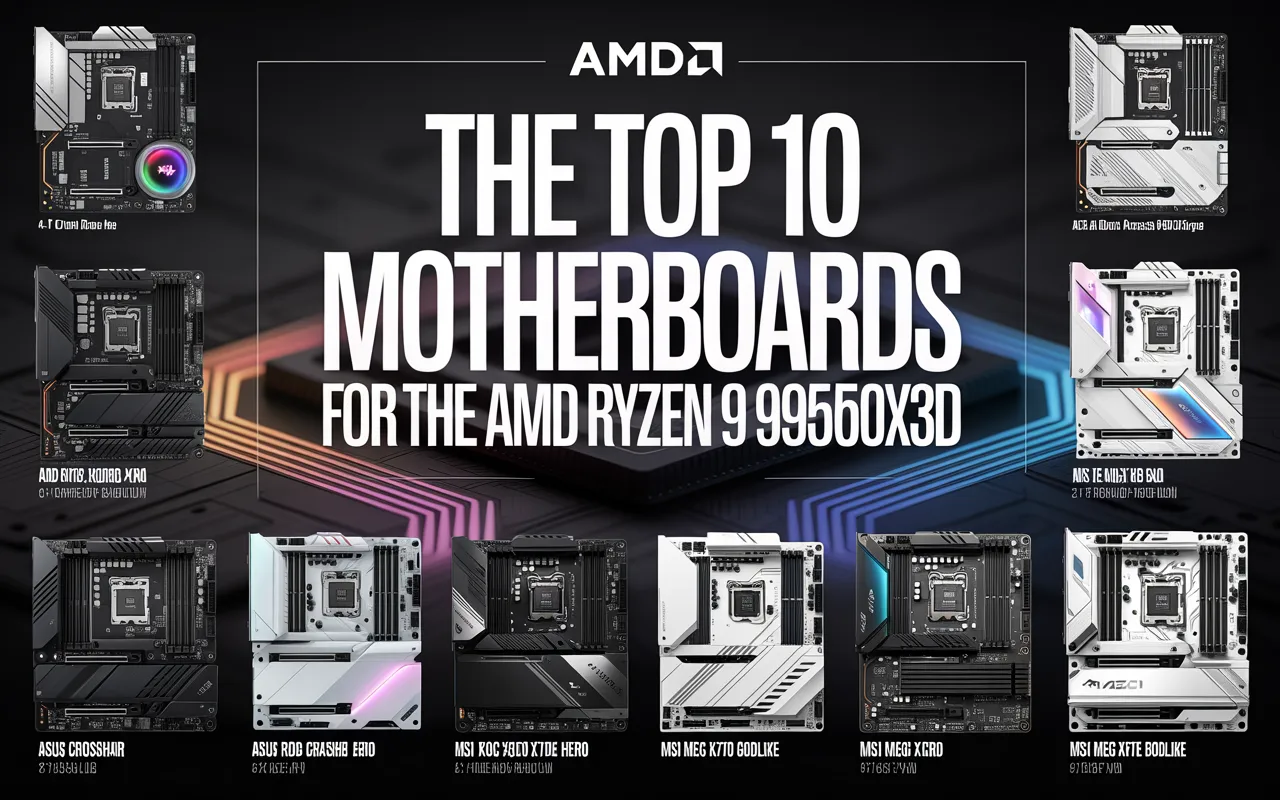
The Top 10 Motherboards for the AMD Ryzen 9 9950X3D Leave a comment
The advent of the AMD Ryzen 9 9950X3D represents a transformative shift in the landscape of high-performance computing, effectively merging the boundaries between professional workstation capabilities and enthusiast-grade gaming prowess. This processor, rooted in the Zen 5 Granite Ridge architecture, utilizes 16 cores and 32 threads to deliver a multifaceted performance profile that leverages the second-generation 3D V-Cache technology. Unlike its predecessors, which often forced a compromise between clock frequency and cache density, the 9950X3D maintains a formidable boost frequency of up to 5.7 GHz, ensuring that frequency-dependent applications do not suffer while providing a staggering 128 MB of L3 cache for latency-sensitive workloads. To achieve this delicate balance, the underlying platform, specifically the Socket AM5 motherboard, must provide an electrical and thermal foundation capable of sustaining a 170W thermal design power and a 230W package power tracking limit.
The Vanguard of Zen 5 Architecture and Platform Requirements
The Ryzen 9 9950X3D is built on a sophisticated multi-chiplet design, featuring two core-complex dies fabricated on the TSMC 4 nm process and a central I/O die produced on the 6 nm node. This silicon configuration hosts 16,630 million transistors, a testament to the density and complexity of the Granite Ridge platform. The primary innovation lies in the asymmetrical cache arrangement, where 64 MB of additional SRAM is stacked beneath one of the eight-core complex dies. This architectural decision places the cache closer to the logic units to minimize latency while allowing the standard core complex die to operate at peak voltages and frequencies for maximum throughput in productivity applications.
Selecting a motherboard for Ryzen 9 9950X3D requires an understanding of the electrical precision demanded by Zen 5. The processor utilizes the AM5 socket, which AMD has committed to supporting until at least 2027, offering a long-term upgrade path that surpasses contemporary competing platforms. However, the high core count and high power limits of the 9950X3D mean that not all AM5 boards are created equal. The power delivery must be clean and stable, as the processor utilizes Precision Boost 2 technology to dynamically adjust its clock speeds every millisecond based on thermal and electrical headroom.
| Processor Specification | Technical Detail |
| Market Segment | Enthusiast Desktop |
| Core and Thread Count | 16 Cores / 32 Threads |
| Base Clock Frequency | 4.3 GHz |
| Maximum Boost Clock | 5.7 GHz |
| L3 Cache Total | 128 MB (64 MB Standard + 64 MB 3D V-Cache) |
| Thermal Design Power | 170W |
| Package Power Tracking | 230W |
| Maximum Operating Temperature | 95°C |
| Transistor Count | 16,630 Million |
| Native Memory Support | DDR5-5600 (Dual Channel) |
| PCI Express Lane Count | 28 Total / 24 Usable |
The integration of such a high-performance chip into a system requires a motherboard that can facilitate rapid data transfer between the CPU and external components. The 9950X3D natively supports PCIe 5.0, providing 24 usable lanes for high-speed graphics and NVMe storage. The choice of chipset, ranging from the enthusiast X870E and X870 to the more mainstream B850, determines the extent to which these lanes are accessible and how they are shared between various slots and ports.
Power Integrity and Electrical Engineering for Zen 5
A fundamental requirement for the Ryzen 9 9950X3D is a robust voltage regulator module system. The VRM is responsible for converting the 12V DC power from the power supply unit into the approximately 1.1V to 1.3V required by the 16-core processor. For a processor with a 230W peak power draw, the motherboard must distribute this current across multiple phases to prevent individual components from overheating or premature failure.
Phase Count and Amperage Capacity
Industry standards suggest that a high-end 16-core processor such as the 9950X3D should be paired with a motherboard featuring at least a 16-phase Vcore VRM design. Advanced topologies, such as teamed power stages or parallel phase configurations, allow for faster transient response, which is crucial when the CPU switches from an idle state to a 5.7 GHz boost state in microseconds. The amperage rating of these power stages, often listed as Smart Power Stages, defines the maximum current each phase can handle. Flagship boards frequently utilize 110A power stages, providing a theoretical capacity far beyond what the 9950X3D will ever draw, thereby ensuring the VRMs operate in their most efficient thermal zone.
The total current I_{Total Current} handled by the VRM can be expressed as:
I{Total Current} = P(CPU)/V(core) x η
is the operating voltage, and η is the efficiency of the power conversion. By increasing the number of phases and using high-quality components, motherboard manufacturers can achieve efficiencies exceeding 90 percent, reducing the waste heat that must be dissipated by the VRM heatsinks.
Printed Circuit Board Design and Signal Integrity
Beyond the VRM, the quality of the printed circuit board itself is pivotal to system stability. PCIe 5.0 signals are incredibly sensitive to electrical noise and trace length. To maintain signal integrity at the 128 GB/s bandwidth of a PCIe 5.0 x16 slot, manufacturers use 8- or 10-layer server-grade PCBs with thickened copper traces. This construction also aids heat dissipation, as the copper layers act as internal heat sinks that spread thermal energy across the board’s surface.
Navigating the AM5 Ecosystem and Chipset Selection
The launch of the Ryzen 9000 series coincided with the introduction of the 800-series chipsets, which represent a refinement over the previous 600-series platforms. The primary differentiator for the X870E and X870 chipsets is the mandatory inclusion of USB4 and PCIe 5.0 support for both the primary graphics slot and the primary M.2 slot.
Architectural Differences between X870E and X870
The X870E chipset is a dual-chip solution that uses two Promontory 21 controllers to provide the maximum possible I/O connectivity. This provides a total of 44 PCIe lanes, enabling multiple high-speed storage drives and peripheral cards without significant lane sharing. The standard X870 chipset, while still offering the essential PCIe 5.0 and USB4 features, uses a single-chip design that results in fewer downstream PCIe lanes for general expansion.
| Chipset Feature | X870E | X870 | B850 |
| PCIe 5.0 Graphics Slot | Required | Required | Optional |
| PCIe 5.0 NVMe Slot | Required | Required | Required |
| Mandatory USB4 (40Gbps) | Yes | Yes | No |
| Native Wi-Fi Standard | Wi-Fi 7 | Wi-Fi 7 | Wi-Fi 7 / 6E |
| Total PCIe Lanes | 44 | 36 | 36 |
| SATA 6Gbps Ports | Up to 8 | Up to 8 | Up to 4 |
| CPU Overclocking Support | Yes | Yes | Yes |
For users who do not require the standard USB4 or a guaranteed PCIe 5.0 graphics slot, the B850 chipset offers a more budget-conscious entry point into the AM5 ecosystem while still providing full support for the Ryzen 9 9950X3D’s performance.
The Role of USB4 and Next-Generation Connectivity
The standardization of USB4 on the 800-series chipsets provides 40Gbps of bidirectional bandwidth, which is essential for professional creators using external storage arrays or high-resolution display docks. This technology often utilizes a dedicated controller, such as the ASMedia ASM4242, which interfaces directly with the CPU lanes to ensure minimal latency and maximum throughput. Furthermore, these boards integrate Wi-Fi 7 solutions that support 320 MHz channel widths and 4K QAM modulation to enabling wireless speeds of up to 5.8 Gbps and rivaling traditional wired Ethernet connections.
Memory Architecture and Latency Optimization
The performance of the Ryzen 9 9950X3D is closely tied to the memory subsystem’s efficiency. While the 128 MB L3 cache significantly mitigates the performance impact of slower RAM in gaming, productivity tasks such as 3D rendering and scientific computations remain highly dependent on memory bandwidth and latency.
Native Support and the Sweet Spot
Zen 5 processors natively support DDR5-5600, but the memory controller can reach much higher frequencies when paired with a high-quality motherboard. For the AM5 platform, a memory frequency of 6000 MT/s is generally considered the optimal balance of performance and stability, as it allows for a 1:1 ratio between the memory clock and the Infinity Fabric clock. Higher frequencies, such as DDR5-8000 or even DDR5-9000, are achievable on high-end boards but often necessitate a 1:2 ratio, which can increase latency unless offset by the raw bandwidth gains.
Innovations in Memory Handling
Modern motherboards have introduced several features to simplify memory optimization. AMD EXPO (Extended Profiles for Overclocking) allows users to apply pre-tested frequency and timing settings with a single BIOS toggle. Some manufacturers have gone further, introducing support for CUDIMMs (Clocked Unbuffered DIMMs), which include an integrated clock driver to improve signal stability at extreme frequencies. Boards such as the MSI MEG X870E GODLIKE and the ASUS ROG Crosshair X870E Apex are engineered with specialized trace layouts and BIOS optimizations to push memory boundaries, which is particularly beneficial for the 32 threads of the 9950X3D.
Top 10 Motherboards for the Ryzen 9 9950X3D
The following selection represents the most capable motherboards for the Ryzen 9 9950X3D, evaluated based on their power delivery, thermal management, connectivity options, and overall value.
1. MSI MEG X870E GODLIKE: The Pinnacle of AM5 Engineering
The MEG X870E GODLIKE is widely regarded as the ultimate platform for the Ryzen 9 9950X3D, offering a feature set that caters to extreme overclockers and high-end professional workstations. It utilizes a massive 24+2+1 Duet Rail Power System with 110A Smart Power Stages, ensuring that even under liquid nitrogen cooling, the electrical supply to the 16-core CPU remains flawless.
One of the defining features of this board is the 3.99-inch Dynamic Dashboard III, an integrated OLED display that provides real-time monitoring of CPU temperatures, clock speeds, and error codes. Networking is equally robust, featuring a dual-LAN configuration with 10Gb and 5Gb Ethernet ports, along with a full-speed Wi-Fi 7 solution. The board also includes the M.2 XPANDER-Z SLIDER GEN5 card, allowing users to install high-speed SSDs into the PCIe slots for easy access and superior cooling.
- Chipset: AMD X870E
- VRM: 24+2+1 Phase (110A SPS)
- Memory Support: DDR5-9000+ (OC)
- Networking: 10GbE + 5GbE LAN, Wi-Fi 7
- Storage: 7x M.2 Slots (up to PCIe 5.0)
For the user who demands no compromises in power or expansion, the GODLIKE represents the absolute halo of the AM5 ecosystem, though its extreme price point limits its reach to the most dedicated enthusiasts.
2. ASUS ROG Crosshair X870E Hero: The Professional Standard
The ROG Crosshair X870E Hero serves as the standard-bearer for high-end AM5 builds, striking a balance between extreme performance and mainstream usability. Its 18+2+2 power-phase design is rated for 110A, providing substantial headroom for the Ryzen 9 9950X3D’s boost behavior.
The Hero is particularly lauded for its storage and connectivity suite, offering five M.2 slots, three of which support the latest PCIe 5.0 standard. Connectivity is handled by dual USB4 ports and a front-panel USB 20Gbps header that supports up to 60W Power Delivery, allowing for fast charging of mobile devices directly from the chassis. The inclusion of SlimSAS connectors further enhances its workstation credentials, allowing for professional storage arrays typically reserved for server-class hardware.
- Chipset: AMD X870E
- VRM: 18+2+2 Phase (110A SPS)
- Memory Support: DDR5-8600+ (OC)
- Networking: 5GbE LAN, Wi-Fi 7
- Storage: 5x M.2 Slots, 1x SlimSAS
The Hero’s BIOS is among the most refined in the industry, featuring AI Overclocking and specialized X3D gaming modes that can prioritize cache-sensitive workloads to the CCD with the 3D V-Cache stack, potentially boosting gaming performance by significant margins.
3. ASRock X870E Taichi: The Build Quality Powerhouse
The ASRock X870E Taichi focuses on hardware fundamentals and legendary durability, featuring a 24+2+1-phase VRM with 20K black capacitors rated for 20,000 hours of operation. This board is designed for users who plan to run the Ryzen 9 9950X3D at sustained maximum loads for extended periods, such as in high-resolution video rendering or complex computational simulations.
Audio performance is a standout feature, as the Taichi integrates an ESS SABRE9219 DAC with WIMA audio capacitors, delivering an audio experience that rivals dedicated high-fidelity sound cards. The board’s I/O is equally impressive, featuring dual USB4 ports that support 40Gbps speeds and 15W Power Delivery, alongside a 5Gb Ethernet port for high-speed wired networking.
- Chipset: AMD X870E
- VRM: 24+2+1 Phase (110A SPS)
- Memory Support: DDR5-8400+ (OC)
- Networking: 5GbE LAN, Wi-Fi 7
- Storage: 4x M.2 Slots (1x PCIe 5.0)
The Taichi’s E-ATX form factor provides a large surface area for heat dissipation, though users must ensure their chassis is compatible with the board’s wider dimensions.
4. Gigabyte X870E Aorus Master: Optimized Storage and Cooling
The X870E Aorus Master is engineered with a specific focus on high-speed data throughput and memory stability, making it an ideal companion for the Ryzen 9 9950X3D in professional creative workflows. It features a digital twin 16+2+2 phase VRM design with 110A power stages, cooled by the massive Fins-Array heatsink system that maximizes surface area for thermal exchange.
Gigabyte has prioritized storage flexibility, providing four M.2 slots, three of which are PCIe 5.0 capable. To manage the heat generated by Gen5 SSDs and high-frequency RAM, the board includes the M.2 Thermal Guard XL and the unique DDR Wind Blade, an active cooling fan designed specifically for the memory modules. The EZ-Latch Plus and EZ-Match systems simplify the installation of large heatsinks and GPUs, making it one of the most builder-friendly boards in the enthusiast segment.
- Chipset: AMD X870E
- VRM: 16+2+2 Phase (110A SPS)
- Memory Support: DDR5-8600 (OC)
- Networking: 5GbE LAN, Wi-Fi 7
- Storage: 4x M.2 Slots (3x PCIe 5.0)
With a 5Gb Ethernet port and dual USB4 ports, the Aorus Master ensures that external connectivity is never a bottleneck for data-intensive tasks.
5. MSI MPG X870E Carbon WiFi: The Balanced Mid-Flagship
The MPG X870E Carbon WiFi occupies a strategic position in the market, offering flagship-level electrical components and connectivity at a price that avoids the extreme premiums of halo products. It utilizes an 18+2+1-phase VRM with 110A Smart Power Stages, effectively matching the power capacity of boards that cost significantly more.
A unique advantage of the Carbon WiFi is its dual Ethernet configuration, featuring both 5Gb and 2.5Gb LAN ports, which provides versatility for users with complex home network setups or home labs. The board’s I/O is exceptionally dense, featuring dual USB4 ports and a wide array of USB 3.2 Gen 2 ports, ensuring compatibility with all modern peripherals. The EZ DIY features, such as the EZ PCIe Release and magnetic M.2 heatsinks, further enhance the user experience by simplifying component changes.
- Chipset: AMD X870E
- VRM: 18+2+1 Phase (110A SPS)
- Memory Support: DDR5-8400+ (OC)
- Networking: 5GbE + 2.5GbE LAN, Wi-Fi 7
- Storage: 4x M.2 Slots (2x PCIe 5.0)
The Carbon WiFi’s black aesthetic and subtle RGB lighting make it a versatile choice for both professional workstation roles and high-end gaming rigs.
6. ASRock Phantom Gaming X870E Nova WiFi: The Performance Value Leader
The Nova WiFi has disrupted the high-end market by offering a 20+2+1 phase VRM and expansive storage options at a highly competitive price point. This board is designed for users who want the maximum possible phase count and storage capacity without paying for aesthetic flourishes or redundant features.
The Nova WiFi offers five M.2 slots, allowing users to build a massive internal storage array for game libraries or video projects. The power delivery system is robust enough to handle the Ryzen 9 9950X3D at its upper overclocked limits, and the board’s memory trace layout supports frequencies of up to 8400 MT/s. Its stealthy design and high-quality cooling solutions make it one of the best-performing boards for VRM thermals.
- Chipset: AMD X870E
- VRM: 20+2+1 Phase (110A SPS)
- Memory Support: DDR5-8400+ (OC)
- Networking: 5GbE LAN, Wi-Fi 7
- Storage: 5x M.2 Slots (1x PCIe 5.0)
For the enthusiast who prioritizes hardware specifications over brand prestige, the Nova WiFi represents perhaps the best purely technical value for the 9950X3D.
7. MSI MAG X870E Tomahawk WiFi: Reliable Mainstream Excellence
The Tomahawk series has long been a staple for builders seeking reliability and essential features, and the X870E version continues this tradition. While it features a more modest 14+2+1 phase VRM with 80A power stages, this configuration is still more than sufficient for the Ryzen 9 9950X3D under standard operating conditions and Precision Boost Overdrive.
The Tomahawk does not skimp on modern connectivity, providing dual USB4 ports, 5Gb Ethernet, and Wi-Fi 7 support. The board’s focus is on stability and ease of use, featuring a simplified BIOS layout and robust thermal solutions for both the VRM and the primary M.2 slots. The tool-less M.2 installation and GPU quick-release mechanisms are included, bringing high-end quality-of-life features to a more accessible price bracket.
- Chipset: AMD X870E
- VRM: 14+2+1 Phase (80A SPS)
- Memory Support: DDR5-8400 (OC)
- Networking: 5GbE LAN, Wi-Fi 7
- Storage: 4x M.2 Slots (2x PCIe 5.0)
The Tomahawk is the ideal choice for users who want a high-performance 16-core system that is built to last without unnecessary complexity.
8. Gigabyte X870E Aorus Elite WiFi 7: The Versatile All-Rounder
The Aorus Elite WiFi 7 is designed to appeal to the broadest possible audience by offering a modern aesthetic, robust power delivery, and high-speed connectivity at a mid-range price. Its 16+2+2-phase VRM with 80A power stages provides stable power to the 9950X3D, while the 8-layer PCB ensures signal integrity in the PCIe 5.0 slots.
This board is particularly strong in networking, featuring Wi-Fi 7 with a high-gain directional antenna that maximizes signal strength in challenging environments. It provides three PCIe 5.0 M.2 slots, offering a superior storage upgrade path compared to many other boards in its class. The inclusion of a front-panel USB 20Gbps header and dual USB4 ports ensures that the board remains relevant as external device speeds continue to increase.
- Chipset: AMD X870E
- VRM: 16+2+2 Phase (80A SPS)
- Memory Support: DDR5-8000+ (OC)
- Networking: 2.5GbE LAN, Wi-Fi 7
- Storage: 4x M.2 Slots (3x PCIe 5.0)
The Aorus Elite WiFi 7 is highly recommended for users who want a board that “just works” while still providing the high-end features necessary to support a flagship CPU.
9. ASUS ROG Strix X870-A Gaming WiFi: The Aesthetic Performance Choice
For users who prioritize the visual appeal of their build, the ROG Strix X870-A Gaming WiFi offers a stunning white-and-silver aesthetic without compromising the high-end technical requirements of the Ryzen 9 9950X3D. It features a robust 16+2 phase VRM with 90A power stages, capable of maintaining stable voltages during intense gaming or creative work.
The Strix X870-A integrates the full suite of ASUS AI features, including AI Overclocking and AI Cooling II, which use intelligent algorithms to optimize system performance and fan noise in real-time. Connectivity is excellent, with Wi-Fi 7, 2.5Gb Ethernet, and dual USB4 ports. The PCIe Q-Release Slim mechanism is a standout feature, allowing users to easily remove their graphics card by simply pulling it from the slot, which is a major convenience in modern builds with large GPUs.
- Chipset: AMD X870
- VRM: 16+2 Phase (90A SPS)
- Memory Support: DDR5-8000+ (OC)
- Networking: 2.5GbE LAN, Wi-Fi 7
- Storage: 4x M.2 Slots (2x PCIe 5.0)
The Strix X870-A is the premier choice for builders aiming for a high-performance white-themed system.
10. ASRock B850I Lightning WiFi: The Small Form Factor Champion
For enthusiasts looking to pack the 16 cores of the Ryzen 9 9950X3D into a compact Mini-ITX chassis, the B850I Lightning WiFi is the most capable board in its segment. Despite its diminutive size, it hosts a 10+1+1 phase VRM with 110A power stages, which is sufficient for the 9950X3D as long as the system has adequate airflow or liquid cooling.
The B850I Lightning provides a PCIe 5.0 x16 slot for the latest graphics cards and two M.2 slots, including one Gen5 slot for a blazing-fast OS drive. It supports memory speeds up to 8200 MT/s, enabling even a compact build to benefit from high-frequency DDR5. While it lacks the extreme expansion of ATX boards, its efficiency and performance density make it a marvel of modern engineering.
- Chipset: AMD B850
- VRM: 10+1+1 Phase (110A SPS)
- Memory Support: DDR5-8200+ (OC)
- Networking: 2.5GbE LAN, Wi-Fi 6E / 7
- Storage: 2x M.2 Slots (1x PCIe 5.0)
Users should be aware that VRM temperatures on Mini-ITX boards can be higher than those on ATX boards, making it essential to pair this board with a high-quality cooling solution.
Storage Management and PCIe Lane Allocation Complexity
One of the most frequent sources of confusion for users of the AM5 platform is the management of PCIe lanes and how they are shared between various slots and ports. The Ryzen 9 9950X3D provides 28 total PCIe 5.0 lanes, of which 4 are dedicated to the chipset link, and 24 are usable for graphics, storage, and I/O.
The x16 Graphics Slot and NVMe Sharing
In a standard configuration, 16 lanes are allocated to the primary graphics slo,t and 4 lanes are allocated to the primary M.2 slot. The remaining 4 lanes are often used for USB4 controllers or secondary M.2 slots. However, many high-end motherboards offer more than one PCIe 5.0 M.2 slot directly connected to the CPU. When a second or third Gen5 SSD is installed, these boards must bifurcate the primary graphics slot, dropping it from x16 to x8 to provide the necessary lanes for the extra storage.
| PCIe Configuration | Graphics Lane Speed | M.2 Slot 1 Speed | M.2 Slot 2 Speed |
| Standard | PCIe 5.0 x16 | PCIe 5.0 x4 | (Chipset Mode) |
| High-Speed Storage | PCIe 5.0 x8 | PCIe 5.0 x4 | PCIe 5.0 x4 |
| Multi-GPU / Expander | PCIe 5.0 x8 / x8 | PCIe 5.0 x4 | (Chipset Mode) |
While PCIe 5.0 x8 provides the same 32 GB per second bandwidth as PCIe 4.0 x16, which is sufficient for current top-tier GPUs such as the RTX 5090, users who demand the full x16 bandwidth for future-proofing or specialized AI tasks should carefully check the manual to identify which M.2 slots trigger this lane sharing.
Chipset Expansion and Downstream Connectivity
The X870E and X870 chipsets provide additional PCIe 4.0 lanes that do not impact the CPU’s primary lanes. These are used for lower-priority M.2 slots, secondary PCIe slots for sound cards or capture cards, and SATA ports for mass storage drives. On boards like the MSI MAG X870E Tomahawk, these chipset lanes are managed exceptionally well, allowing for multiple drives to be used simultaneously with minimal impact on overall system throughput.
Thermal Dynamics of High-End AM5 Systems
Managing the heat generated by a 16-core processor and high-speed motherboard components is critical for maintaining performance over long periods. The Ryzen 9 9950X3D has a T Max of 95°C, meaning it will begin to throttle its clock speeds if it reaches this threshold.
VRM Cooling and Heatsink Design
The voltage regulator modules are the primary heat sources on the motherboard. High-end boards utilize large, finned aluminum heatsinks connected by copper heatpipes to dissipate this energy. The use of 7W/mK or even 9W/mK thermal pads ensures efficient heat transfer from the power stages to the heatsinks. In some extreme cases, such as the ASRock X870E Taichi or the Gigabyte X870E Master, active cooling fans are integrated into the VRM shroud or the memory area to prevent thermal soak during extended heavy workloads.
SSD Thermal Management
PCIe 5.0 SSDs are notorious for their high operating temperatures, which can lead to severe thermal throttling and data transfer speed drops if not properly managed. Modern motherboards address this by providing massive M.2 heatsinks, often with multiple layers of cooling material. Features like Gigabyte’s M.2 Thermal Guard XL and MSI’s Shield Frozr II provide a high thermal mass that can absorb and dissipate the heat from the fastest drives currently on the market.
Practical Integration and System Stability Best Practices
Achieving a stable, high-performing system with the Ryzen 9 9950X3D requires more than just high-quality hardware; it also requires proper firmware management and system-level optimization.
BIOS Updates and AGESA Support
The performance of 3D V-Cache processors is heavily dependent on the motherboard’s AGESA (AMD Generic Encapsulated Software Architecture) version. For the 9950X3D, users must ensure their BIOS is updated to at least AGESA 1.2.0.3a or later to ensure the operating system handles the asymmetrical CCD configuration correctly. Most modern boards provide a BIOS Flashback function, allowing for updates to be performed via a USB drive without needing a CPU or memory installed, which is an essential feature if the board’s factory BIOS does not natively recognize the new processor.
Operating System and Driver Optimization
To maximize the benefits of the 3D V-Cache, the system should ideally be running Windows 11 24H2, which includes specific optimizations for the Zen 5 branch prediction unit and task scheduling. Additionally, the latest AMD Chipset Drivers are necessary to allow the 3D V-Cache Performance Optimizer to communicate with the Windows Game Mode scheduler. This ensures that gaming workloads are sent to the CCD with the extra cache, while multithreaded productivity tasks utilize both CCDs for maximum throughput.
Power Supply Integrity
Given the high power draw of the Ryzen 9 9950X3D and the potential for flagship GPUs like the RTX 5090 to draw over 450W, the use of a high-quality ATX 3.1-compliant power supply is mandatory. A PSU rated for 850W or 1000W with 80 Plus Gold or Platinum efficiency ensures that the system has sufficient headroom to handle the transient power spikes common in modern high-performance hardware. The motherboard’s dual 8-pin EPS connectors should always be fully populated to ensure stable power delivery to the 16-core CPU.
Final Synthesis and Procurement Advice
The AMD Ryzen 9 9950X3D is a singular achievement in processor design, offering a unique value proposition for those who require both workstation-class multithreading and the world’s best gaming performance. However, the processor’s reliance on precise power delivery and high-speed I/O makes the motherboard the most critical factor in the build’s success.
For users who demand the absolute pinnacle of technology and have an unrestricted budget, the MSI MEG X870E GODLIKE and ASUS ROG Crosshair X870E Hero represent the current peaks of the AM5 platform. Those focused on the best possible build quality and power delivery per dollar will find the ASRock X870E Taichi and ASRock Phantom Gaming X870E Nova WiFi to be unbeatable options. For the mainstream enthusiast, the MSI MAG X870E Tomahawk WiFi and Gigabyte X870E Aorus Elite WiFi 7 offer all the necessary modern features, including USB4 and Wi-Fi 7, at a price that allows for greater investment in high-capacity RAM and storage.
Regardless of the specific model chosen, selecting an X870E or X870 motherboard ensures the system is ready for the future of PCIe 5.0 peripherals and high-bandwidth networking. By following the principles of robust VRM selection, efficient thermal management, and careful BIOS optimization, builders can ensure that their Ryzen 9 9950X3D system remains a high-performance cornerstone for years to come.