
No products in the cart.

Analysis of the Graphics Processing Unit Market in Pakistan: A Comprehensive Evaluation of Performance Tiers, Architectural Shifts, and Economic Realities in 2026 Leave a comment
The graphics processing unit (GPU) market in Pakistan has reached a critical juncture in early 2026, characterized by a complex interplay between global technological breakthroughs and local macroeconomic volatility. As the Pakistani Rupee (PKR) continues its fluctuations against the US Dollar (Dollar), the acquisition of computing hardware has evolved from a standard consumer purchase into a strategic long-term investment for gamers, freelance content creators, and the burgeoning community of artificial intelligence researchers. This report provides an exhaustive technical and economic analysis of the GPU landscape in Pakistan, evaluating the merits of various NVIDIA architectures ranging from the legacy Turing series to the newly launched Blackwell 50-series. The analysis is structured into three primary performance divisions—Budget, Midrange, and High Performance—while accounting for the specific infrastructural challenges, such as thermal management in subtropical climates and the necessity of high-quality power delivery systems.
The Global Silicon Landscape and the 2026 Memory Crisis
To accurately assess the Pakistani market, one must contextualize the local availability of hardware within the 2026 global memory shortage. This crisis, driven primarily by the astronomical demand for High Bandwidth Memory (HBM) and GDDR7 in AI data centers, has significantly constrained the supply of consumer-grade video random access memory (VRAM). Hyperscale enterprises such as Microsoft, Amazon, and Meta have prioritized the acquisition of memory-intensive AI accelerators, often outbidding the consumer market for fabrication capacity at foundries like TSMC.
In Pakistan, this has translated into a retail environment where MSRP (Manufacturer’s Suggested Retail Price) serves as an idealized benchmark rather than a reality. Retailers in major urban centers like Karachi, Lahore, and Faisalabad have seen prices for high-end cards like the RTX 5080 and 5090 exceed their initial launch figures by 45% to 75% due to these supply constraints. Furthermore, the anticipated “Super” refresh for the Blackwell architecture, which many expected to debut at CES 2026, was reportedly shelved as NVIDIA pivoted its existing GDDR7 supply toward more profitable enterprise-grade AI chips. This stagnation in the new hardware cycle has placed renewed importance on the used market and previous-generation architectures like Ampere (30-series) and Ada Lovelace (40-series).
Architectural Overview: The Evolution of Neural Rendering
The shift from 2020 to 2026 represents a fundamental change in how performance is measured. While raw rasterization—the traditional method of drawing polygons—remains relevant, the era of “Neural Rendering” has firmly taken hold. This transition is defined by the integration of AI-driven upscaling and frame generation technologies.
| Architecture | Generation | Key Innovation | Impact on Pakistani Users |
| Turing | 16/20 Series | Hardware Ray Tracing & DLSS 1.0 | Introduced the possibility of RT in budget builds. |
| Ampere | 30 Series | Massive CUDA Density & Resizable BAR | Solidified 1440p gaming as the new standard. |
| Ada Lovelace | 40 Series | Frame Generation (DLSS 3) | Enabled high-refresh gaming on low-wattage setups. |
| Blackwell | 50 Series | Multi-Frame Generation (DLSS 4) | Generating up to 3 AI frames per 1 rendered frame. |
For the Pakistani consumer, who often maintains hardware for three to five years, these architectural differences are critical. A card’s longevity in 2026 is no longer just a function of its transistor count, but its ability to leverage the latest Deep Learning Super Sampling (DLSS) iterations to bypass hardware limitations in modern, path-traced titles like Cyberpunk 2077 or Black Myth: Wukong.
Budget GPU Solutions: Navigating the Entry-Level Segment (PKR 40,000 – 100,000)
The budget division in Pakistan is currently defined by a mixture of aging high-performance cards from the Turing era and modern entry-level offerings that prioritize efficiency. This segment is essential for the vast majority of local gamers who target a 1080p resolution and for students entering the fields of graphic design and video editing.
The Legacy Vanguard: GTX 1660 Super and RTX 2060
The GTX 1660 Super remains one of the most frequently traded GPUs in the Pakistani used market, particularly at outlets like TechMatched and Daddu Charger, where it is often priced between ₨45,000 and ₨50,000. Despite its lack of dedicated Ray Tracing cores, its 6GB of GDDR6 memory and Turing architecture allow it to remain a viable 1080p workhorse for competitive titles such as Valorant, CS2, and Fortnite. However, in the context of 2026, its inability to support DLSS significantly limits its ceiling in modern AAA titles where FidelityFX Super Resolution (FSR) is the only available upscaling lifeline.
The RTX 2060, by comparison, offers a much more robust value proposition for roughly ₨63,000. The inclusion of first-generation Tensor and RT cores allows users to access DLSS, which can provide a 25–30% performance boost over the GTX 1660 Super in supported games. For a Pakistani gamer on a strict budget, this card represents the “floor” for a modern, feature-complete PC experience.
The 8GB Transition: RTX 2060 Super and RTX 2070
As modern game textures and 1080p complex assets increasingly demand more than 6GB of VRAM, the RTX 2060 Super and RTX 2070 have become highly sought-after in the pre-owned market. Priced around ₨60,000 to ₨75,000, these cards provide an 8GB GDDR6 buffer, which is necessary to avoid the stuttering and texture pop-in seen in VRAM-limited scenarios. The RTX 2070, while older, still delivers respectable performance in 1440p gaming with DLSS set to “Quality” mode, making it an excellent bridge for users who have upgraded their monitors but cannot yet afford a 30 or 40-series card.
The Blackwell Entry Point: RTX 5050 and Market Scarcity
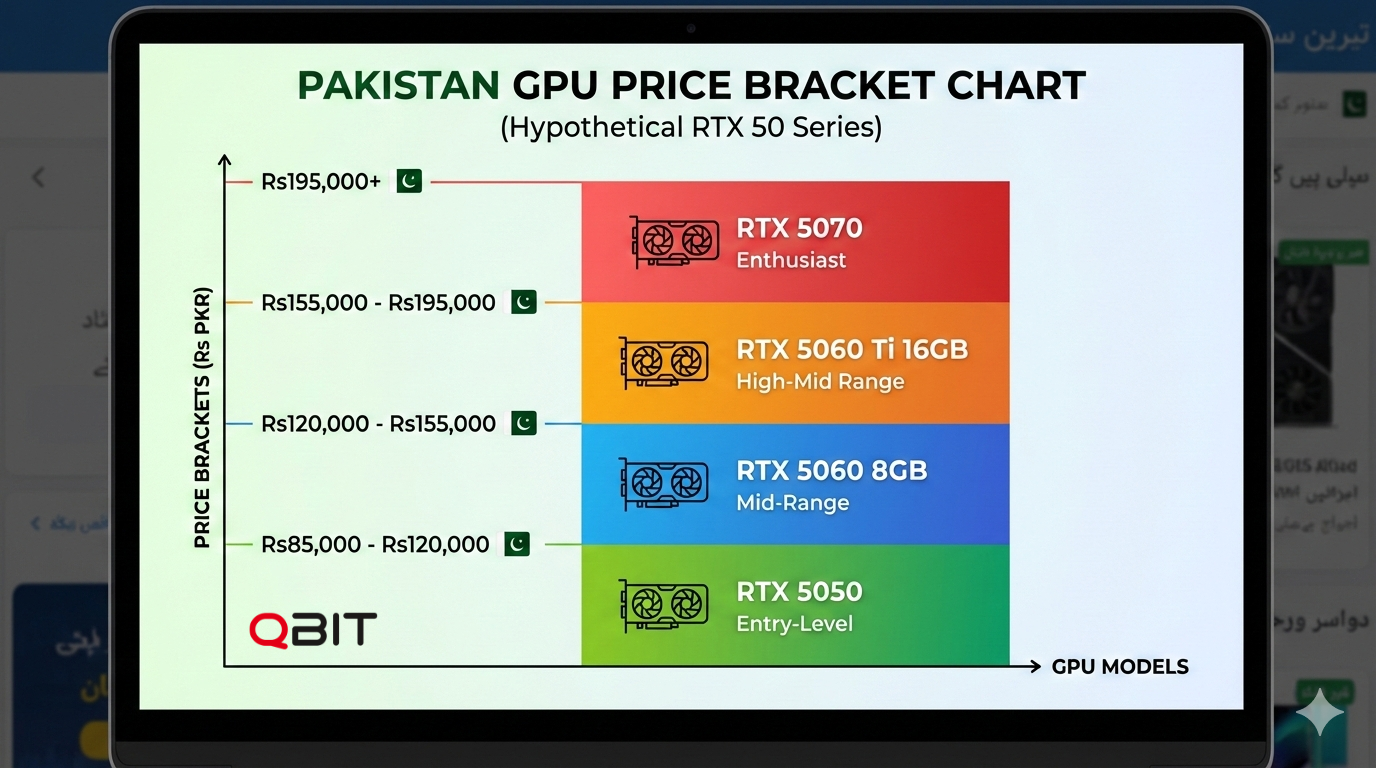
The newly released RTX 5050 represents the first time the 50-class has entered the Pakistani market with a focus on neural rendering. With 8GB of GDDR6 memory and full support for DLSS 4, the RTX 5050 effectively matches the raw performance of the RTX 4060 while offering superior AI upscaling capabilities. In the Pakistani retail sector, the RTX 5050 occupies the ₨85,000 to ₨95,000 price bracket. While expensive for an entry-level card, its 5nm Blackwell architecture and PCIe 5.0 interface make it the most future-proof budget option available for new PC builds in 2026.
Budget GPU Comparison Table (February 2026)
| GPU Model | VRAM | Architecture | Used Price (PKR) | New Price (PKR) | Primary Use Case |
| GTX 1660 Super | 6GB GDDR6 | Turing | 45,000 – 48,000 | N/A | Budget 1080p Gaming |
| RTX 2060 | 6GB GDDR6 | Turing | 60,000 – 65,000 | N/A | Entry-level DLSS Gaming |
| RTX 2060 Super | 8GB GDDR6 | Turing | 60,000 – 68,000 | N/A | 1080p Ultra/1440p Entry |
| RTX 2070 | 8GB GDDR6 | Turing | 65,000 – 75,000 | N/A | 1440p Medium Gaming |
| RTX 3050 (6GB) | 6GB GDDR6 | Ampere | 55,000 – 60,000 | 70,000 – 75,000 | Low-power Office/Casual |
| RTX 5050 | 8GB GDDR6 | Blackwell | N/A | 85,000 – 95,000 | Next-gen 1080p AI |
Midrange Performance: The Professional and Enthusiast “Sweet Spot” (PKR 100,000 – 250,000)
The midrange division is where the competition between generations is most fierce. This tier is critical for the “freelance economy” in Pakistan, where thousands of creators use their systems for 4K video editing, 3D modeling, and local AI inference.
The Ampere Resurgence: RTX 3060 and RTX 3070
One of the most notable trends of 2026 is the enduring popularity of the RTX 3060 12GB. Originally released in 2021, its 12GB VRAM buffer has turned it into a “legacy champion” for creators who cannot afford high-end Blackwell hardware. In Pakistan, used RTX 3060 12GB cards fetch around ₨75,000 to ₨85,000, outperforming the newer 8GB RTX 4060 in specific creative tasks like large-scale texture rendering in Blender.
The RTX 3060 Ti, often confused with the rumored but non-existent “3060 Super,” remains a favorite for 1440p gamers. Priced around ₨85,000 to ₨95,000 in the used market, it provides a significant rasterization lead over the standard 3060, though its 8GB buffer is increasingly becoming a limitation for ultra-textured titles. The RTX 3070, at ₨90,000 to ₨105,000, offers even greater performance but suffers from the same 8GB VRAM bottleneck in 2026’s landscape.
The Efficiency Leaders: RTX 4060 and RTX 4060 Ti
The Ada Lovelace midrange cards—the RTX 4060 and 4060 Ti—are primarily distinguished by their exceptional power efficiency. In a country like Pakistan, where electricity costs have risen and voltage stability is a constant concern, a GPU that delivers high performance at under 160 watts is a major advantage.
The RTX 4060 Ti 16GB variant is particularly relevant for Pakistani content creators. At approximately ₨150,000, it is the most affordable card that provides a 16GB VRAM buffer, making it the “gold standard” for 4K video editing in DaVinci Resolve Studio and long-form rendering in Blender. For gamers, the standard RTX 4060 remains a solid 1080p ultra card, retailing for ₨110,000 to ₨125,000.
The Blackwell Midrange: RTX 5060 and RTX 5060 Ti
The arrival of the Blackwell 60-series has brought GDDR7 memory to the midrange for the first time. The RTX 5060, while still limited to 8GB in its base configuration, features a 25% bump in CUDA core count and a much faster memory interface than the 4060. Its real-world performance advantage is approximately 28–29% over the previous generation at 1080p, though this gap narrows at higher resolutions due to the VRAM bottleneck.
The RTX 5060 Ti 16GB is perhaps the most anticipated card for the Pakistani prosumer. Retailing for ₨175,000 to ₨195,000, it combines the 16GB GDDR7 buffer with 5th-generation Tensor cores, enabling 2x faster AI upscaling and significantly reduced render times for 3D animation.
Midrange GPU Comparison Table (February 2026)
| GPU Model | VRAM | TDP | Used Price (PKR) | New Price (PKR) | Key Feature |
| RTX 3060 | 12GB GDDR6 | 170W | 75,000 – 85,000 | 95,000+ | High VRAM for Creators |
| RTX 3060 Ti | 8GB GDDR6 | 200W | 85,000 – 95,000 | N/A | 1440p Rasterization King |
| RTX 3070 | 8GB GDDR6 | 220W | 90,000 – 105,000 | N/A | Solid 1440p Enthusiast |
| RTX 4060 | 8GB GDDR6 | 115W | 95,000 – 105,000 | 110,000 – 125,000 | Extreme Power Efficiency |
| RTX 4060 Ti | 16GB GDDR6 | 160W | 125,000 – 140,000 | 150,000 – 165,000 | Affordable 4K Editing |
| RTX 5060 | 8GB GDDR7 | 145W | N/A | 120,000 – 135,000 | Neural Rendering Entry |
| RTX 5060 Ti | 16GB GDDR7 | 180W | N/A | 175,000 – 195,000 | Future-proof Creator Card |
High-Performance and Enthusiast GPUs: The 4K and AI Frontier (PKR 250,000 – 1,700,000+)
The high-performance division in Pakistan is currently witnessing a massive price disparity. While previous-generation flagship cards have become relatively affordable in the used market, the new Blackwell flagships are commanding “luxury” prices that reflect their utility in professional AI development and high-end 8K production.
The Enthusiast Sweet Spot: RTX 5070 and 5070 Ti
The RTX 5070 and 5070 Ti have emerged as the premier choices for Pakistani enthusiasts who want 4K gaming capabilities without the million-rupee price tag of the 5090. The RTX 5070, featuring 12GB of GDDR7, provides a significant generational leap over the 4070, maintaining 80+ FPS in most 1440p titles at ultra settings. Its local retail price is approximately ₨210,000 to ₨235,000.
The RTX 5070 Ti, however, is the true standout for the enthusiast. With 16GB of GDDR7 on a 256-bit bus, it effectively matches the memory bandwidth of the older RTX 4080 but with the added benefits of Blackwell’s architecture. At ₨320,000 to ₨350,000, it is the most logical high-end purchase for those who intend to use their systems for both AAA gaming and serious 3D motion design.
The Flagship Powerhouses: RTX 5080 and 5090
The RTX 5080 and 5090 are the undisputed leaders of the 2026 market. The RTX 5080, priced at ₨450,000 to ₨550,000, delivers performance that surpasses the legendary RTX 3090 by nearly 64% in synthetic benchmarks. With 16GB of GDDR7, it handles 4K path-traced gaming with minimal reliance on aggressive upscaling.
The RTX 5090, however, is a card of unprecedented scale. Featuring 32GB of GDDR7 and 21,760 CUDA cores, it is the only consumer GPU capable of handling trillion-parameter AI models and uncompressed 8K video timelines. Its price in Pakistan reflects its dual role as an enterprise tool and a gaming card, reaching as high as ₨1,700,000. Despite the cost, it has sold out in minutes globally and locally, as Pakistani tech companies and research labs compete with high-end enthusiasts for the limited stock.
High-Performance GPU Comparison Table (February 2026)
| GPU Model | VRAM | Bus Width | New Price (PKR) | Target Resolution / Use Case |
| RTX 3080 | 10GB GDDR6X | 320-bit | 125,000 (Used) | High-value 1440p/4K |
| RTX 3080 Ti | 12GB GDDR6X | 384-bit | 145,000 (Used) | Professional 3D Rendering |
| RTX 4070 | 12GB GDDR6X | 192-bit | 185,000 – 200,000 | Efficient 1440p Ultra |
| RTX 5070 | 12GB GDDR7 | 192-bit | 210,000 – 235,000 | Next-gen 1440p |
| RTX 5070 Ti | 16GB GDDR7 | 256-bit | 320,000 – 350,000 | Enthusiast 4K / Studio Work |
| RTX 5080 | 16GB GDDR7 | 256-bit | 450,000 – 550,000 | Ultimate 4K Gaming |
| RTX 5090 | 32GB GDDR7 | 512-bit | 1,600,000 – 1,800,000 | AI / 8K Pro Video |
Technical Evaluation for Content Creators: Beyond Gaming Benchmarks
For the Pakistani professional community, a GPU is a tool of production. The requirements for video editing, 3D animation, and AI development are fundamentally different from those of gaming.
Video Editing in Premiere Pro and DaVinci Resolve
In Adobe Premiere Pro, the GPU primarily accelerates effects rendering and the encoding/decoding of compressed codecs like H.264 and HEVC. NVIDIA’s dual NVENC/NVDEC encoders in the Blackwell series allow for simultaneous 4:2:2 hardware decoding, which is essential for professional mirrorless and cinema camera footage. For a 4K timeline in DaVinci Resolve, a minimum of 8GB VRAM is required, though 12GB (RTX 3060/4070/5070) is the recommended “safety zone” to prevent out-of-memory errors during color grading.
3D Rendering and Animation in Blender Cycles
Blender’s Cycles engine utilizes the OptiX API to leverage RT cores for hardware-accelerated ray tracing. The RTX 5090 has demonstrated rendering speeds 35% faster than the 4090, allowing studios to iterate on complex scenes in real-time. For the Pakistani freelancer working on a budget, the RTX 3060 12GB or the RTX 4060 Ti 16GB provide the best “VRAM-per-PKR” ratio, allowing for larger scene complexities that would crash an 8GB card.
Artificial Intelligence and Machine Learning
The rise of local Large Language Models (LLMs) and Stable Diffusion image generation has created a new segment of GPU buyers. NVIDIA’s dominance in this field is absolute due to the CUDA software stack. For local development, the 16GB buffer on the RTX 5060 Ti or 5070 Ti is the minimum for training small models (7B parameters) using QLoRA techniques. The RTX 5090, with 32GB, is the only consumer card capable of high-throughput inference for larger models without significant quantization loss.
Infrastructure and Longevity: The Pakistani Operational Context
Operating high-performance hardware in Pakistan introduces unique challenges that are rarely discussed in international reviews. Thermal management, power quality, and currency depreciation are critical factors in the total cost of ownership.
Thermal Management: The Triple-Fan Necessity
The ambient temperature in cities like Multan or Lahore can exceed 45°C during the summer months. High-TDP cards like the RTX 5090 (575W) and RTX 5080 (360W) require specialized cooling solutions to maintain clock speeds. Entry-level dual-fan models, while cheaper, often hit thermal limits in Pakistani summer conditions, leading to decreased lifespan and performance. For high-end Blackwell cards, triple-fan arrays or hybrid liquid cooling (such as the MSI Lightning Z) are not just luxuries but necessities for hardware survival.
Power Delivery: The PSU and UPS Equation
The Revised 12V-2×6 power connector used in the 50-series requires high-quality, stable current. Pakistani users are strongly advised to utilize ATX 3.1 compliant Power Supply Units from reputable brands like Corsair or Seasonic. A “Tier A” 850W or 1000W PSU is essential for high-end builds to handle the transient power spikes inherent in the Blackwell architecture. Furthermore, given the frequency of power outages (load shedding), a high-quality online UPS is critical for protecting the GPU’s voltage-sensitive components.
The “AI Tax” and Currency Hedging
In 2026, GPUs have become a form of “silicon gold” in Pakistan. Because prices are so closely tied to the USD/PKR exchange rate, purchasing a high-end card like the RTX 4090 or 5090 acts as a partial hedge against local inflation. The resale value of cards with high VRAM has remained remarkably high because they can be repurposed for AI compute clusters even as they become obsolete for gaming.
Future Outlook: The Market in 2027 and Beyond
The 2026 memory crisis has essentially halted the mid-cycle “Super” refresh for the Blackwell architecture, meaning the current lineup of cards will remain the flagship standard until at least 2028. For Pakistani buyers, this provides a rare window of “purchase stability.” A card bought in February 2026 is unlikely to be superseded by a significantly better value-proposition within the next 18 to 24 months.
However, the entry-level market remains under pressure. The rumored return of the RTX 3060 to production in early 2026 highlights the inability of the modern 5nm and 4N nodes to produce enough affordable silicon to meet global demand. For the Pakistani student or casual gamer, this means that the used market will continue to be the primary source of affordable hardware for the foreseeable future.
Conclusion: Strategic Recommendations for Local Buyers
The Pakistani GPU market in 2026 is one of extremes. While the entry-level segment is struggling with aging hardware and memory shortages, the high-end segment has seen unprecedented performance gains through the Blackwell architecture.
For the Budget Gamer, the strategic choice is the RTX 2060 Super (Used) or the RTX 5050 (New). These cards provide the necessary 8GB buffer to handle modern titles with DLSS support, which is essential for performance longevity.
For the Professional Content Creator, the RTX 4060 Ti 16GB or the RTX 5060 Ti 16GB represent the best return on investment. The 16GB VRAM buffer is the single most important factor for modern 4K production and 3D rendering workflows.
For the High-End Enthusiast, the RTX 5070 Ti is the most balanced choice, offering 4K capability and 16GB of GDDR7 memory at a price that, while high, avoids the extreme “AI premium” seen in the flagship models.
Finally, the Enthusiast/AI Prosumer must accept the current market reality: the RTX 5090 is a transformative tool whose ₨1.7 million price tag reflects its ability to replace entire workstation clusters of previous generations. In all cases, Pakistani buyers must prioritize thermal management and power stability to protect these significant investments in an increasingly volatile technological and economic landscape.